
This experience takes 20/30 min. The doors are open from 5 to 7PM. Please confirm your assitance via TG @nicoechaniz or @anniesci
Harmonic Resonance Experience Making the interference pattern of the subtle audible in the material realm.
Overview
The Harmonic Resonance Experience is an exploration into how human presence interacts with resonant systems. It is the first prototype of a long-imagined instrument: a self-playing acoustic guitar tuned to a natural harmonic progression centered on the resonant frequency of its body. This tuning transforms the instrument into a harmonic resonant surface—a living interface between sound, emotion, and field.
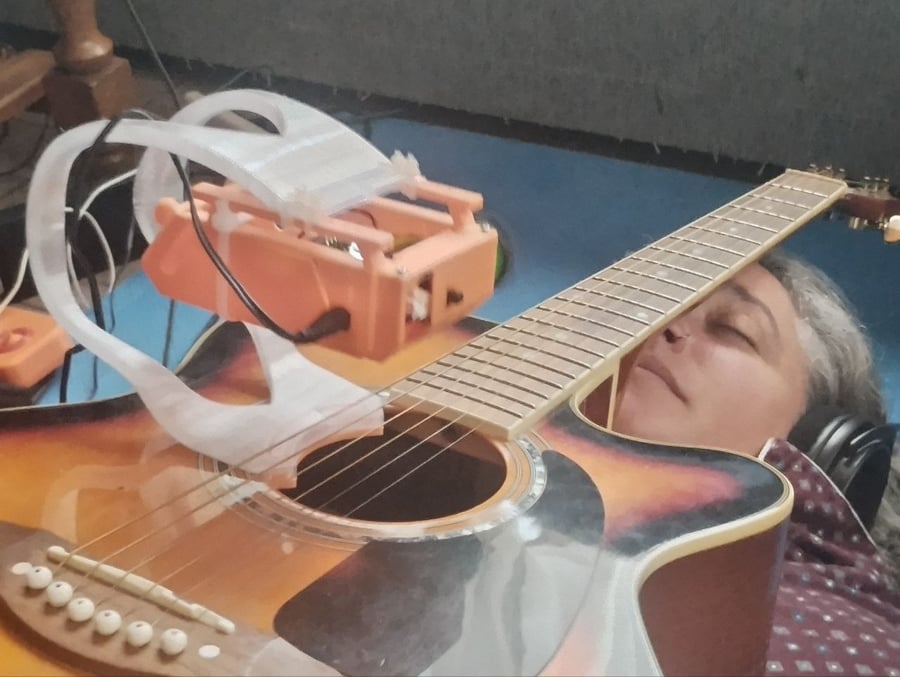
The Device At its core lies a guitar continuously strummed by a 3D-printed mechanism operating at its own resonant frequency. This rhythmic excitation creates evolving interference patterns across the instrument. Each string sympathetically vibrates with the others, forming complex harmonic textures that seem to “listen” and respond to the environment. The guitar becomes an amplifier for the unseen — a translator of subtle vibrations into audible form.
The Experience Participants describe an uncanny sense of auditory pareidolia: within the layered harmonics, they begin to perceive melodies that feel self-generated yet are undeniably present in the sound. When they listen to the recordings later, those melodies persist. However, others who hear the same recording do not perceive the same motifs — unless the original listener hums them first. Once pointed out, the melodies become audible to all, as if consciousness tunes reality into coherence.
The Hypothesis Every human field — emotional, cognitive, energetic — interacts with the environment as a dynamic resonance pattern. The resonant surface reveals this interaction acoustically. The resulting recording encodes a person’s harmonic signature, a unique interference imprint of their field on the instrument’s natural harmonics.
Experiment Protocol (Edge City Prototype) 1. Each participant spends 10 minutes near the resonant guitar while it plays continuously. 2. The session is recorded, capturing the composite harmonic field. 3. Immediately after, the participant sings or hums any melodies that emerged most clearly to them. 4. These two recordings — the harmonic field and the sung melody — together form the participant’s harmonic signature.
Analysis & Implications By examining frequency ratios and harmonic relationships in each person’s recording, we aim to explore correlations between musical intervals and emotional states — e.g., melancholy in a minor third or tension in an augmented fourth. These ratios may represent universal expressions of resonance between psyche and sound. Ultimately, the experiment seeks to answer:
Can a resonant system audibly reveal the subtle patterns of human presence?