
Register/报名链接:https://luma.com/m5c2phaf
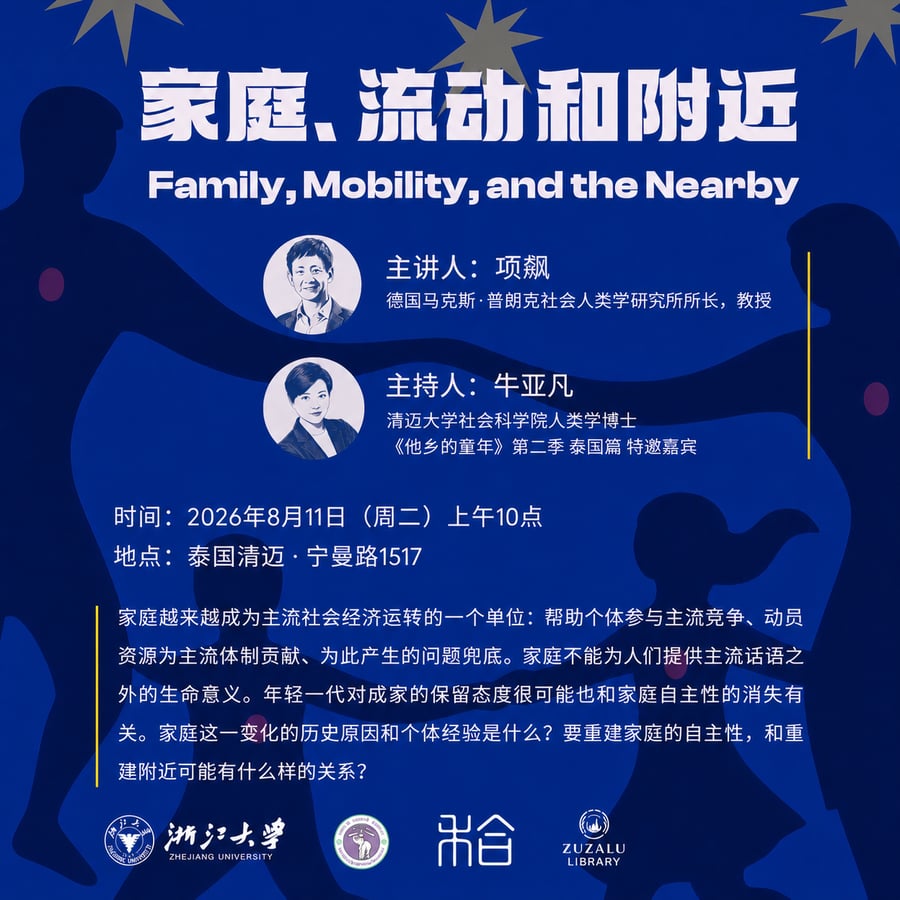
主讲人:
项飙 Xiang Biao
德国马克斯·普朗克社会人类学研究所所长,教授
Director and Professor, Max Planck Institute for Social Anthropology, Germany
主持人:
牛亚凡 Niu Yafan
清迈大学社会科学院人类学博士
《他乡的童年》第二季 泰国篇 特邀嘉宾
Ph.D. Candidate in Anthropology,
Faculty of Social Sciences, Chiang Mai University
家庭越来越成为主流社会经济运转的一个单位:帮助个体参与主流竞争、动员资源为主流体制贡献、为此产生的问题兜底。家庭不能为人们提供主流话语之外的生命意义。年轻一代对成家的保留态度很可能也和家庭自主性的消失有关。家庭这一变化的历史原因和个体经验是什么?要重建家庭的自主性,和重建附近可能有什么样的关系?
It is premature to predict that the family as a demographic unit—through which population reproduces itself-- may disappear soon, but it can be argued the family as a cultural unit, that is, an institution with distinct cultural values and autonomous norms, is declining in some parts of the world. The family in China since the 2000s has become a unit not only "in", but also "of", the dominant socio-economic system. The family prepares individuals for fierce competition in education, work, commerce and social status, mobilizes resources to maintain the established institutional order (e.g. education), and ultimately absorbs costs generated by the very system (e.g. mental stress).
The family often intensifies the pressure exerted by the large system on individuals, rather than providing forms of life and meaning beyond the mainstream narratives. This trend can be a main cause for the rapid decline in family formation among the young population.
Is this trend simply a reversal to the pre-1980s era when family was a unit of the planned economy? How have individuals experienced the ongoing transformation? Can the reconstruction of "the nearby", including through transnational mobilities, contribute to the reconstruction of the family as a cultural unit?
为了保证活动质量,请大家报名时提交自己的问题或观点,通过审核后一起参与讨论。
To ensure the quality of the event, please submit your own question or viewpoint when registering; after approval, you will be invited to join the discussion.
联合主办:
浙江大学人类学研究所
清迈大学社会科学学院
合禾联大
Zuzalu ChiangMai